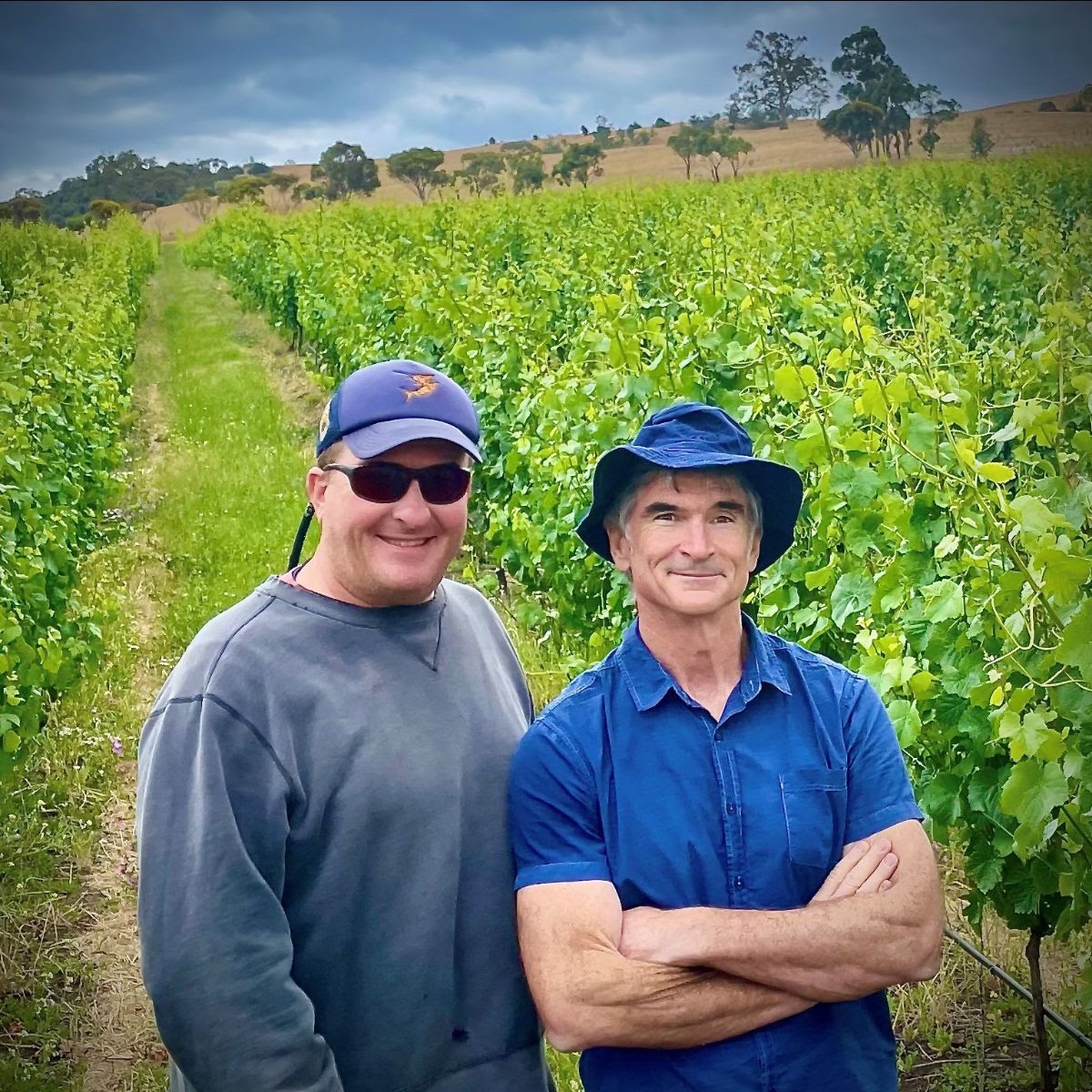
It’s one of London’s most traditional wine businesses, with an estate that includes several haunts beloved by City types, including the fabled El Vino bars. But throughout its history, Davy’s has never been afraid to change course. Might a pivot towards more hybrid wine shops be the next move? Graham Holter talks to chairman James Davy (pictured left with MD Andrew Chudley)
What exactly is Davy’s? It really depends on which angle you view it from.
The company runs the sort of old-school wine bars that Rumpole of the Bailey would recognise. It imports, and distributes, wines from family estates across Europe and beyond. It has a hybrid wine shop and bar in central London in addition to the store at its Greenwich HQ. It sells cigars and snuff in Covent Garden. But you could ignore all of the above and simply go ten-pin bowling at the alley it opened in a spare upstairs space in 2024. (It’s called Vintners Lanes.)
Chairman James Davy exudes the calm wisdom of a man imbued with the experience not just of his own wine career but that of four generations who went before him. This is a business that has survived two world wars, depression, recession and pandemic.
There are new challenges to face now, driven by government policy and lifestyle changes as well as the sluggish economy. As a family business, Davy’s can ride out lean years without worrying about restless shareholders. But tough decisions have to be made.
Last December, it closed one of its best-known wine bars, The Crusting Pipe in Covent Garden. Davy sets aside any sentimental attachment to the site and describes the decision to hand back the keys as a positive move for the business.
“Go back to 1980 and imagine what Covent Garden was like. It was the place to go in London,” he says. “When we opened there, it was just refurbished from its fruit and veg past. We were an anchor tenant, and there were queues down the street. We were there for 45 years and, for 35 of them, it was by far our most successful business.”
Davy estimates that 50% of customers were international tourists, 25% domestic visitors and 25% local workers and residents. But Brexit began to take its toll, and other parts of London – Davy cites Borough Market, the South Bank and Camden as examples – began to broaden their appeal.
Suddenly, Covent Garden was quiet after 8pm. “Effectively we were losing a session a day in a very expensively rented place,” he says. “So we have mixed feelings. I’m quite glad to get out, actually, because something that’s been amazing can become pretty tragic in a short space of time. It wasn’t a case of The Crusting Pipe having had its day. It hadn’t at all. Covent Garden’s had its day.”
Davy was similarly phlegmatic when, in 2024, the company offloaded its in-bond wine storage, broking and en primeur services to Jeroboams. He explains: “The deal we did with them really worked for us: we still keep that customer list, so we still sell fine wine to all those people, just not en primeur or in bond, until November this year, and then we can do what we want again.”
Does Davy think his forebears would recognise the modern incarnation of the business?
Wine has always been at the core of its mission, he maintains. “When we started in 1870 it was a wine house – other people might have called it a pub. It majored in wine in a way that lots of people didn’t.
“From there, a wholesale business emerged, and that grew. We had cellars in Barking, and we had a number of wine houses; we had a number of wine shops. We started own-label in the early 1900s.
“We still have wine shops. We still have wine houses, with all the wine bars. Nobody [in the early years] could have foreseen my father starting wine bars properly – no longer in pub premises – and an era where the City of London just drank all day, every day. People were introduced to a new concept: wine was approachable, and made available in a way that had never been done before.
“That was why we became known as Davy’s Wine Bars. Everyone forgot about the wine merchants and all the rest of it for a period of 40 years. It was astonishingly successful.”
Davy suggests the current model is nearer to the earlier ethos of the company. But he thinks his predecessors would be surprised by the popularity of new world wine – and the way consumption patterns have changed: “What do you mean, nobody drinks? What do you mean, they don’t come to work?”
Since 2020, “people have developed a magnetic attraction to going home” rather than heading for an after-work drink. Alcohol plays a diminishing role in many lifestyles. And, Davy argues, we’ve become rather more “brittle” as a nation.
“If it’s too hot outside, people won’t get on a train. If it’s too cold, they won’t get on the train. If it’s too wet, they won’t get on the train. Give them another reason: if there’s a tube strike coming in two weeks’ time, they probably won’t get on a train today. And if they were on a train like I was on last night, where it’s just hell and takes two hours, they won’t get on a train tomorrow.” None of this is good news for hospitality operators.
Davy’s has a wholesale wine list that’s easy to love. Not because it ticks every box – it definitely doesn’t – but because the producers it works with (including for its own-labels) are usually small-scale, sustainable enterprises making genuinely interesting wines in a very non-shouty sort of way. Whisper it, but the prices often look like misprints too. There is value to be had.
France makes up about 70% of sales, and while tradition plays a part in the selection process, both Davy and managing director Andrew Chudley are keen to emphasise that the focus is also on producers with a more dynamic approach.
Davy’s does not work as an agency business, but has been keen to forge alliances with regional partners across the UK to build bigger distribution for its range – including among independents, who currently account for about 30% of its wholesale trade.
“Because we’re quite small and quite nimble, we can work well with these emerging producers who don’t really want mass market. It’s not the kind of relationship where we’ve got to sell 1,000 cases,” Davy says.
Chudley has been gradually adding wines to the line-up: Bodegas del Río, a fairly new sherry house, is supplying a manzanilla which has got the team energised.
“We’re bringing in some Cypriot wines this year, and they’re very exciting,” he adds. “We brought in some Montsant wines last year, from Josep Grau – they’re unbelievable.
“We brought in a few Beaujolais producers last year as well, including some really interesting fine wine and drinking vintages.”
Davy isn’t concerned that the new world is being left behind in the portfolio. “Durigutti in Argentina are amazing – and being aligned with a really, really good winery, that we represent exclusively, is probably OK at the moment in terms of what we need from there. The same really applies to our relationships in South Africa, Chile and New Zealand.
“We’ve got Stonyridge, which is considered by some to be the best wine out of New Zealand; Te Kano, where there’s been enormous investment and the wines are of huge quality. Those are two really different boutique, very high-end producers to work with. Mount Brown is more volume, but they make lovely wine. So there’s quite a lot going on in those other countries.”
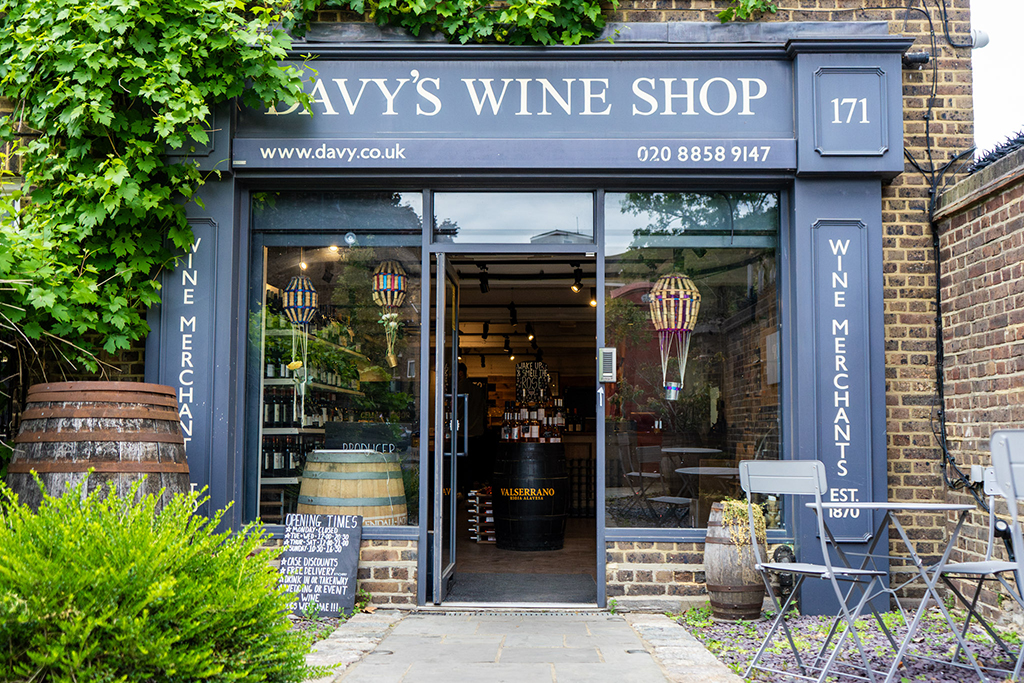
Davy’s has spacious shop in Greenwich, which has the advantages of being both rent-free and a short walk from the station. “It’s not really the right location,” Davy admits. “Although we’ve had a bit of luck, because the DLR in Greenwich town centre is shut. So, for the best part of a year, we’ve had people coming past here who would normally go straight to the centre. We’ve seen quite a significant increase in trade and some of that might stick.”
Then there’s the hybrid branch in Holborn. “It’s probably less turnover, because it’s not such a big place, and you can’t drive to it, but it has quite good spend,” Davy says.
“We also have a couple of tiny kiosk shops by El Vino Fleet Street and El Vino Blackfriars: you get quite a steady number of people popping in because they need something better than they’ll get in one of the supermarkets.”
Online sales are also significant. “It was a small business that grew tenfold during the 18 months of Covid,” Davy reports. “It then went to half that, to a quarter that, and now it’s just better than it was pre-Covid.” Davy’s has only modest ambitions for further online growth, given that its direct competitors are big spenders such as Laithwaites and The Wine Society.
The days when companies like Davy’s had cash sloshing around in the bank to invest in expansion projects are long gone. Its most recent accounts at Companies House (for the year to March 30, 2025) report an operating loss of £715,000 on turnover of almost £7.2m. The numbers are an improvement on the previous year, and the company has equity of nearly £9m to conjure with. But the economic climate remains precarious – and, like its rivals, Davy’s has been battered by rising labour costs and business rates.
Given the pressures facing hospitality at the moment, it’s not surprising that Davy is cautious about exposing the company to unnecessary risk. But is he ever tempted to open a Davy’s shop and bar in a market or commuter town within striking distance of the capital?
“We’d love to do hybrid wine shops,” he says. “They extend the brand. We’re very confident with our portfolio, only because people tell us it’s great, which is nice. So we’re very confident to move further afield.”
It’s a more attractive option, he believes, than online expansion: “Because that has distribution and couriers and it’s not glamorous.”
It’s also a more affordable prospect than setting up anything resembling The Crusting Pipe.
He says: “When you look at the difference between setting up a bar-restaurant in the City of London or the West End in 3,000 square feet … it’s a pretty depressing number.
“These days, you might get change from £2m if it’s a nice, relatively well-done place. I think you can set up a hybrid wine shop for probably £100,000 – and that’s quite a nice one – and the rent will be a third or a quarter or even a fifth of what it would be for the bar-restaurant.
“You can be very flexible, too, because the investment’s not so great, and therefore the lease term doesn’t need to be so great.
“So that would be an interesting area to invest in, much more so than further bars and restaurants. We have some really good ones, so we’ve got to keep maintaining those. We have others where we need to consider whether they’ve got a future. I love them, and the people that go there love them, but from a P&L point of view they’re not very attractive.
“So we need to de-risk out of that in order to move forward. And, luckily for us, we’ve got different strings to our bow.”